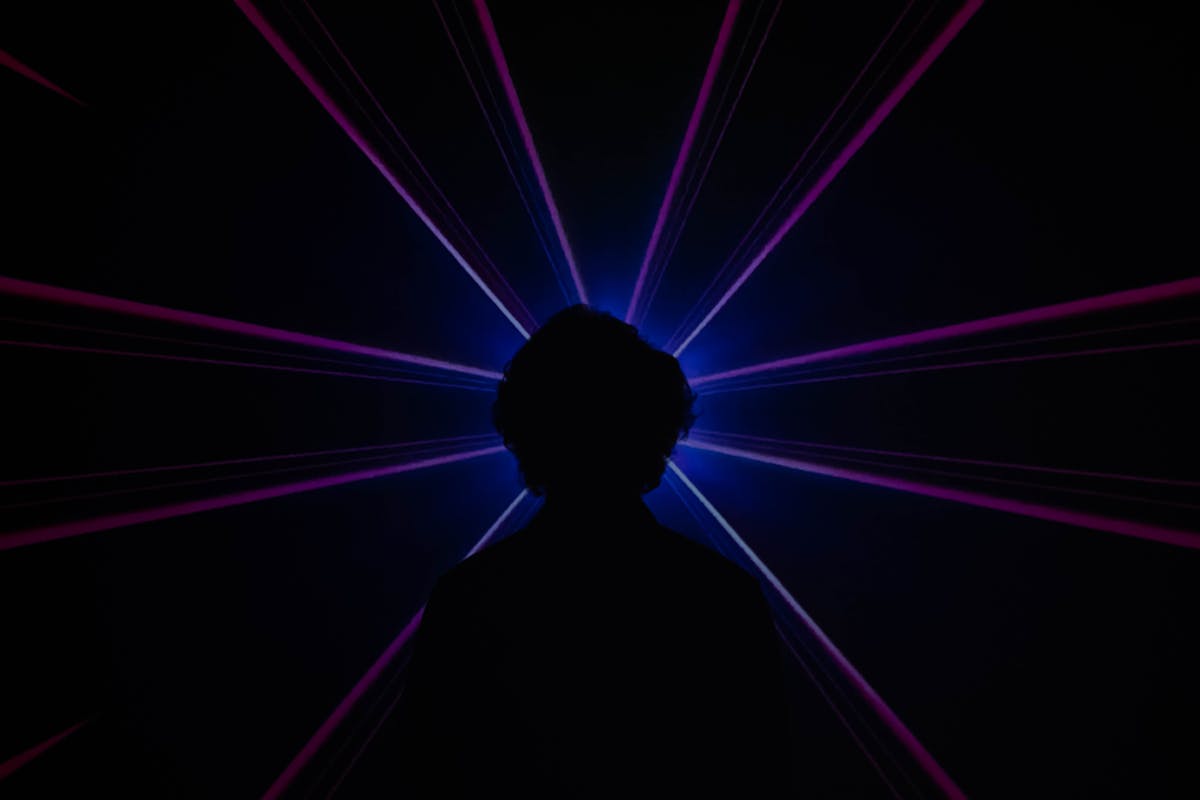
The properties of light are the handful of behaviours that explain almost everything you see: light travels in straight lines, reflects, refracts, disperses into colours, interferes, diffracts, and can be polarised. Master those seven and you can explain mirrors, rainbows, camera lenses, soap-bubble colours, and the glare-killing trick in polarised sunglasses. Here's where we're going — each property built from a picture you already own, then the real physics and the numbers.
What are the properties of light?
Light is a transverse electromagnetic wave. That single fact sits underneath every property below. The wave is a ripple of electric and magnetic fields, it carries energy, and it travels at 299,792,458 metres per second in a vacuum — fast enough to circle the Earth about 7.5 times in one second. It needs no medium, which is why sunlight crosses empty space to reach us.
From that one nature, seven behaviours follow. Six of them — reflection, refraction, dispersion, interference, diffraction, and polarisation — are the wave properties of light, the things only a wave can do. The seventh, travelling in straight lines, is what you notice first. All seven properties of light trace back to the same wave, which is why learning one makes the next easier. (Britannica's overview of light is a good companion reference; for what light is and the energy it carries, see our guide to what light energy is.)
Light travels in straight lines (rectilinear propagation)
In a uniform medium, light moves in straight paths called rays. This is rectilinear propagation, and you've seen the proof: a torch beam in dusty air is a straight line, and a sharp-edged object casts a sharp-edged shadow. If light curved on its own, shadows would have fuzzy, bent edges.
The catch is "uniform medium." Light only bends when something changes — a new material, a boundary, an edge. Take those away and it runs dead straight. That's why the remaining properties of light are all about what happens when light meets something.
Reflection — why light bounces back

Reflection is light bouncing off a surface instead of passing through. The rule is tidy: the angle of incidence equals the angle of reflection, both measured from the line perpendicular to the surface. Throw a ball straight down at the floor and it bounces straight back; throw it at a slant and it leaves at the mirror-image slant. Light does exactly that.
A smooth surface like a still lake or a polished mirror reflects rays that stay parallel, so you get a clear image. A rough surface scatters them every which way — which is why you can't see your face in a brick wall even though it reflects plenty of light. (NASA's overview of how light behaves walks through reflection alongside the other behaviours.)
Refraction — why light bends in water
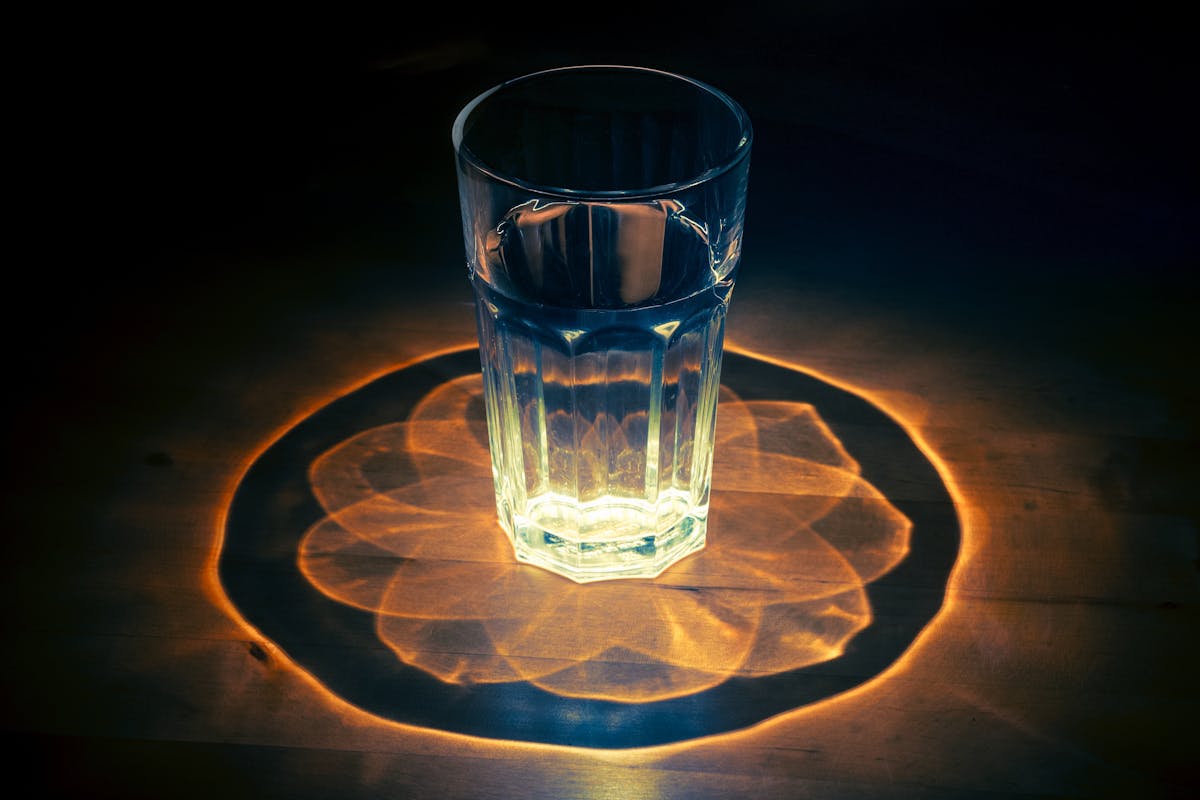
Refraction is the bending of light as it passes from one transparent medium into another. A straw in a glass of water looks snapped at the surface — that's refraction, not a broken straw.
Here's the picture. Imagine a car rolling at an angle off smooth tarmac onto soft sand. The wheel that hits the sand first slows first, so the whole car pivots toward that side. Light does the same thing entering water: the part of the wave that reaches the surface first slows first, and the beam swings. The honest version: light isn't "dragged" — the medium's charges respond to the wave and re-radiate, and the combined wave travels slower. The amount of bending follows Snell's law, n₁ sin θ₁ = n₂ sin θ₂, where n is each medium's refractive index. Light slows from 299,792,458 m/s in vacuum to about 225,000 km/s in water (n = 1.333) and 197,000 km/s in crown glass (n = 1.52).
Dispersion — how light splits into colours
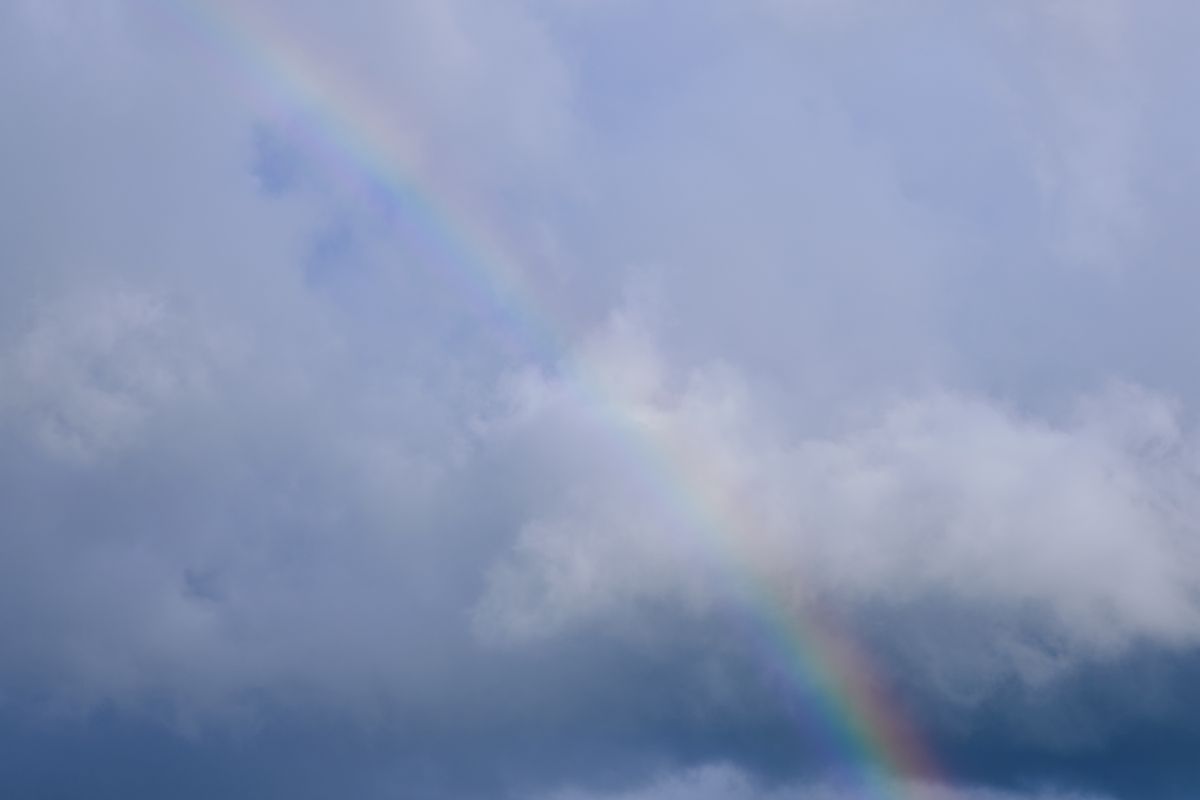
Dispersion is what happens when refraction sorts white light into its colours. A prism or a raindrop turns sunlight into a rainbow because each colour bends by a slightly different amount.
Think of it like a crowd leaving a stadium: blue-shirted fans move a touch slower through the gate than red-shirted ones, so the streams fan apart. Each colour has a marginally different refractive index — blue is bent more than red — so the single white beam spreads into a band. The colours were never added by the prism; they were inside the white light all along, and refraction just separates them by wavelength, from violet near 380 nm to red near 700 nm.
Interference — when waves add up or cancel
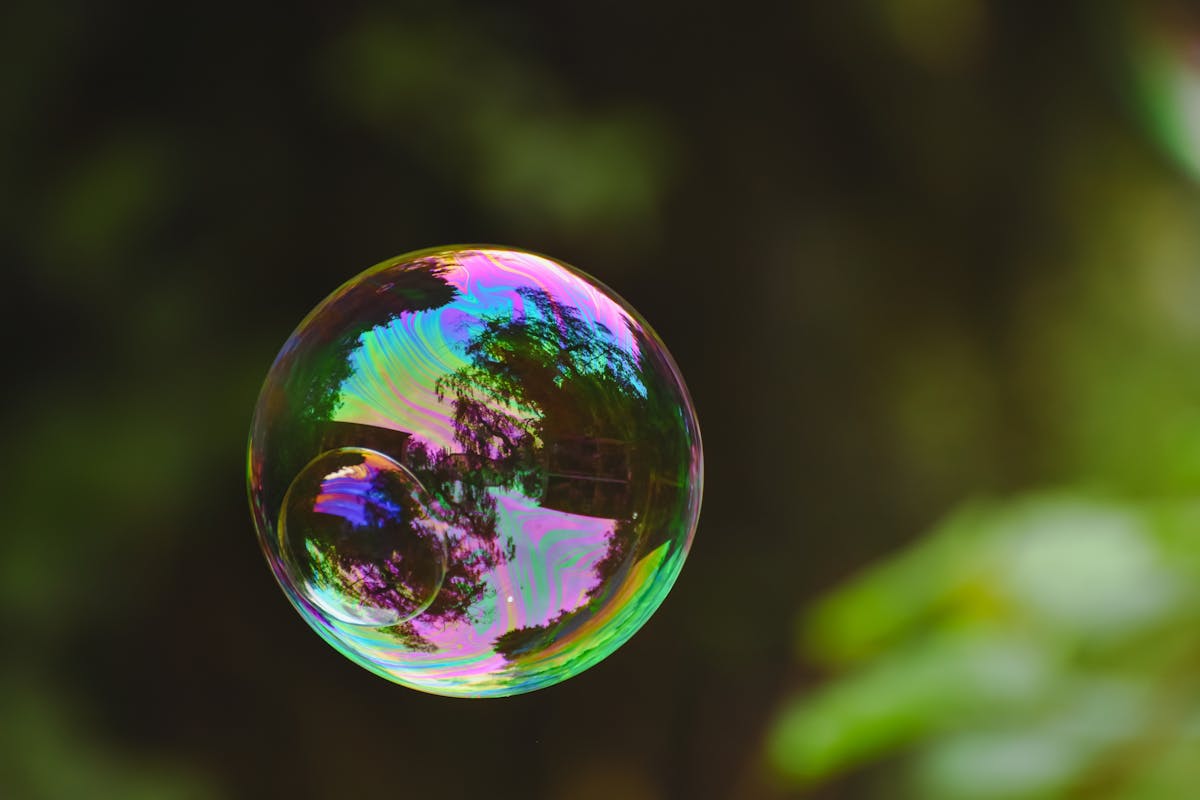
Interference is two light waves overlapping and either reinforcing or cancelling. The swirling colours on a soap bubble or an oil slick are interference at work — light reflecting off the top and bottom of a paper-thin film, the two reflections meeting either in step or out of step.
Picture two stones dropped in a still pond. Where two crests meet, the water piles higher; where a crest meets a trough, they flatten to nothing. Light does the same: in step makes a bright band, out of step makes a dark one.
Around 1801, Thomas Young shone light through two narrow, closely spaced slits. He expected two bright lines. Instead he got a row of light and dark bands. Particles arriving can only add up — they can't produce darkness where light meets light. Overlapping waves can. Young's fringes were the decisive evidence that light is a wave, and the fringe spacing follows Δy = λL/d — wider fringes for longer wavelengths and a more distant screen.
Diffraction — how light bends around edges

Diffraction is light spreading out as it passes an edge or a narrow opening. Tilt a CD or DVD and you see a rainbow sweep across it — the tightly packed tracks act as a diffraction grating, bending each colour by a different angle (d sin θ = mλ).
Here's a way to see it: sea waves passing through a narrow harbour mouth don't stay a tidy beam — they fan out in arcs on the far side. Sound does it too, which is why you can hear someone around a corner before you see them. Light diffracts by the same rule, but there's a subtlety: its wavelength is tiny, around 500 nm — roughly 100–200 times thinner than a human hair. That's why you don't notice light bending around everyday corners; the effect only shows up at slits and edges close to its own wavelength.
Polarisation — filtering the direction of the wiggle
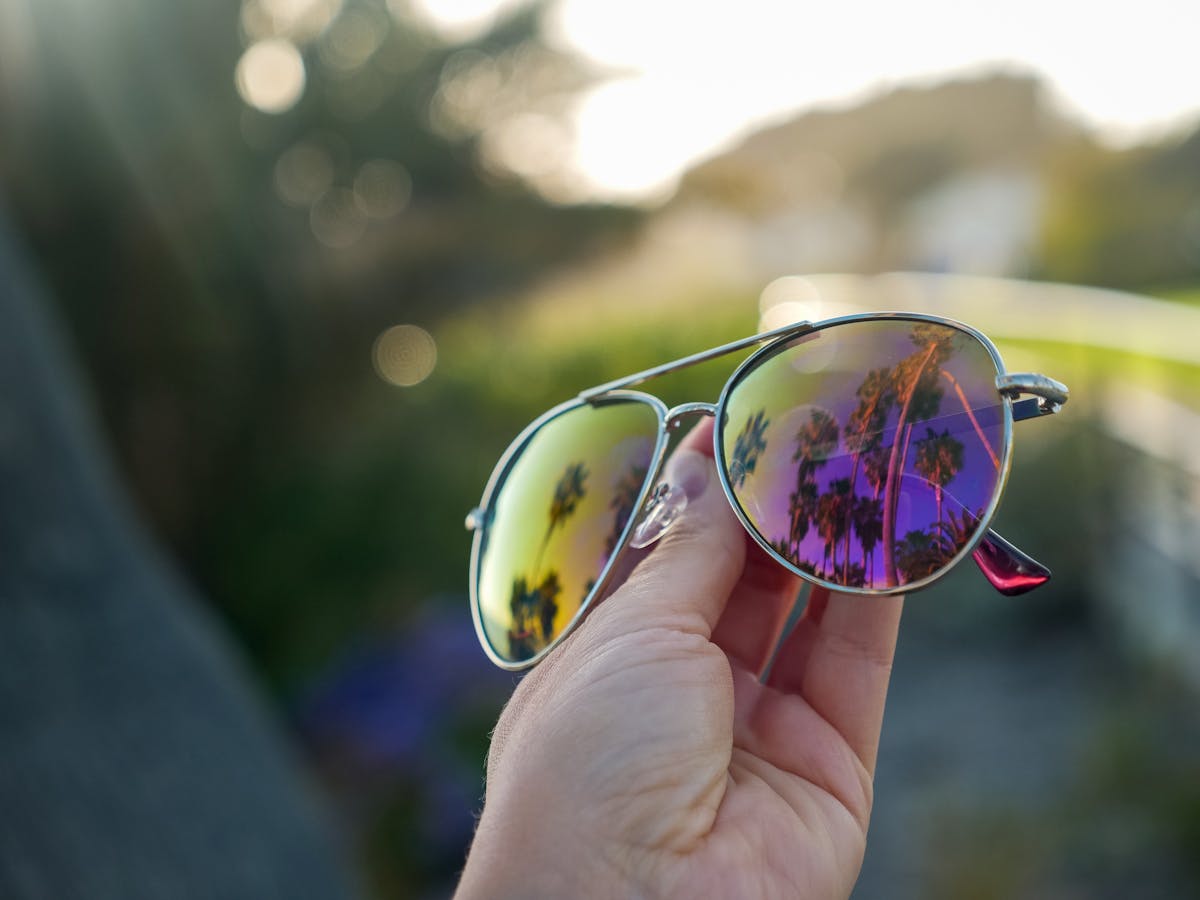
Light is a transverse wave, so its fields wiggle side to side as it travels. Polarisation is filtering those wiggles down to a single direction. Think of a rope shaken up and down, threaded through a vertical picket fence: only the up-and-down wiggle gets through, and turning the fence 90° blocks it entirely. A polariser does that to light, and a second one rotated against it dims the beam by Malus's law, I = I₀ cos²θ.
Here's a misconception worth fixing: polarised sunglasses don't work by being darker. A plain dark lens just dims everything evenly. Polarised lenses instead block one orientation of light — specifically the horizontally-polarised glare that bounces off water, roads, and car bonnets. That's why they kill blinding reflections a regular tinted lens can't, while leaving the rest of the scene clear. The darkness is a side effect; the filtering is the point. (Britannica's article on polarisation covers the wave mechanism in more depth.)
Is light a wave or a particle?
All six wave properties above scream "light is a wave." Yet light also arrives in indivisible packets — photons — and effects like the photoelectric effect only make sense if it does. So which is it? Both, and neither.
Picture a cylinder. From one angle it casts a circular shadow; from another, a rectangular one. Both shadows are real, yet neither is the cylinder. Light is like that: our experiments reveal a wave face or a particle face, but the thing itself is neither a simple wave nor a simple particle. The honest move, the one physicists actually make, is to name which model you're using for the job in front of you. Most of the everyday properties of light belong to the wave face — for reflection and rainbows, the wave model pays; for the energy of a single photon, the particle model does.
Where you see the properties of light every day
The properties of light aren't lab curiosities — every one is in plain sight once you know the name:
- Reflection: mirrors, still water, the glow of the Moon (sunlight bounced our way).
- Refraction: glasses and contact lenses, camera and phone lenses, a straw looking bent in a drink.
- Dispersion: rainbows, the fire inside a cut diamond, the colour fringe at the edge of a cheap lens.
- Interference: soap bubbles, oil films on a wet road, the anti-reflective coating on spectacles.
- Diffraction: the rainbow on a CD, the spikes around a streetlight seen through a misted window.
- Polarisation: sunglasses cutting glare, LCD screens, photographers darkening a blue sky.
One original diagram for this article: a single white ray hitting a glass block, with each property branching off it — part reflecting at the surface (reflection), part bending as it enters (refraction), the bent beam fanning into colours (dispersion), and a wavefront spreading past the block's edge (diffraction). One picture that shows all the wave behaviours sharing the same origin.
For the bigger picture of what light is and how it carries energy, start with our light energy guide, or browse the rest of our optics guides.
Frequently Asked Questions
What are the 7 properties of light?
The seven key properties of light are: rectilinear propagation (it travels in straight lines), reflection, refraction, dispersion, interference, diffraction, and polarisation. Underlying all of them, light is a transverse electromagnetic wave that travels at 299,792,458 metres per second in a vacuum and needs no medium.
What are the wave properties of light?
The wave properties of light are the behaviours that only make sense if light is a wave: reflection, refraction, dispersion, interference, diffraction, and polarisation. Interference and diffraction are the strongest proof — particles can't cancel each other out to make dark fringes, but overlapping waves can.
What property defines how an element reflects light?
Reflectivity (also called reflectance) defines how well a surface reflects light. It depends on the material's electronic structure and surface finish: polished metals like silver reflect over 95% of visible light, while a black surface absorbs most of it. Colour comes from which wavelengths a material reflects versus absorbs.
Is light a wave or a particle?
Both, depending on how you look at it. Light shows wave behaviour in interference and diffraction, and particle behaviour (photons) in effects like the photoelectric effect. Neither picture is the whole truth — each is a model that captures one face of something that is neither a simple wave nor a simple particle.
What are the qualities of light?
In physics, the qualities of light are its measurable properties: speed, wavelength (which sets colour), frequency, amplitude (which sets brightness), and its wave behaviours — reflection, refraction, dispersion, interference, diffraction, and polarisation. In art and photography, 'quality of light' instead means how hard or soft a light source is.
Does light need a medium to travel?
No. Unlike sound, light is an electromagnetic wave and travels through a vacuum. That is why sunlight crosses 150 million kilometres of empty space to reach Earth in about 8 minutes 20 seconds. It can also travel through transparent media like air, water, and glass, where it slows down.

About Umar Farooq
Umar Farooq writes in-depth guides on the physics of light and optics — from reflection, refraction, and lenses to diffraction, lasers, and fiber optics, explained from first principles.
Read more about Umar Farooq →